|















©
2005-2026
Man From Mars Productions

|
| |
 |
By
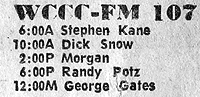
the fall of '69 you were on WCCC A/F, then programming MOR. I thought
you fit in great as a relaxed morning driver. Was this good practice
for the laidback, non-hype AOR delivery you would take to WHCN a
year later?
|
|
| |
WCCC was a strange
experience. But again, the late 60s were strange and bloody times,
maybe the most violent years in this country outside of the Civil
War. I worked for Morgan Tell, a great guy who I'd work for again
several years later in Chicago. It gave me more of a sense of myself
as a personality without the hype, but they were skittish about
playing songs that were border rock and roll. I mean, "Suite
Judy Blue Eyes?" No. But "Our House?" Oh, okay. Cute.
Then the station was sold and in clomped Sy Dressner, who told me
one day - I was programming it by then - that he didn't want any
songs played where you could "hear the bass through the wall."
Ha! That's right up there with my being told not to play any piano
pieces in morning drive, or - quoting here -- "no screaming niggers,
like Johnny Mathis." All true. Sad, but absolutely true.
|
|
| |
Your
e-mail indicated you were "moving toward a more counterculture
perspective." The next major chunk of your career was at what
we used to call "underground FM" stations.
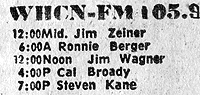
That lasted
about as long as Flower Power. But what a ride. Like trying to interpret
Firesign Theatre logically. From WHCN ($99 a week, no deductions),
to WBCN, to WGLD Chicago, WNCR Cleveland, CJOM Windsor, Ontario,
the most radical of the bunch, and KPRI San Diego. At CJOM I inherited
the PD's job - who was an ex-pat avoiding the draft - and held sway
over the likes of Kokaine Karma, a former member of the Rainbow/White
Panther Party.
|
|
|
| |
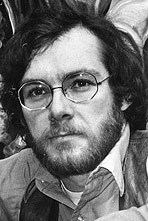
Stephen
Capen at
WNCR Cleveland |
We were out
to test the limits of the Canadian Communications Commission. Fired
en masse and locked out on Thanksgiving Day. It was pretty wild.
In the end the owner decided we were out of control after hearing
what he deemed a "farting contest" on my two-man morning show with
Larry Himmel. Actually we'd created a character named "Sheena" and
her voice was the sound effect of a creaking door off a Disney album,
so that's apparently where he got that idea. Course, calling the
mayor of Windsor a cocksucker probably didn't help.
By
the time you reached San Francisco, you had many notches in your
radio belt. At what point did you give up playing records and morph
into a journalist?
I have to say
here that joining KSAN was a redux in the progressive radio experience,
short-lived as it was, but still happening in 1980 and that's pretty
late in the free form game. It also opened the door to other morning
shows for me in San Fran where they game me carte blanche. We pulled
off some pretty outrageous theatre, and all this was pre-Morning
Zoo crap with no reliance on bodily function jokes, tits n' ass,
or the mentally deficient to reap laughs. Can ya say "prurience?"
|
|
| |
In 1990
I took up the flag, if you will, of investigative journalism
and wrote a piece on a Japanese transnational marketing a
bioengineered food supplement that people were actually using
as a sleeping pill. Someone close to me had been paralyzed
then killed by it. The company was dirty, cutting back on
purification to get the product out. The Village Voice ran
the story and I thought I was off to a respectable start,
full of high hopes. But like they say, keep your day job,
and I continued to work for various radio outlets in the Bay
area, at one point simultaneously contributing to San Francisco
Magazine, really unsatisfying given that city magazines are
basically lists and fluff.
Can
you clarify this - was it you who worked at WXRK New York,
or someone else with a similar name?
That'd
be me. It's funny because quite a few people have commented
on my work for CBS Radio News when in fact that's someone
named Steve Cathen, who coincidentally started on the
air when I was stringing for CRN in 1998, filing reports on
nouveau Deadheads from the Rainbow Family Gathering in Arizona.
Gets confusing, doesn't it? But yes, I went to K-ROCK in afternoon
drive where I made the agreement with Howard Stern that I'd
take the audience from the waist up and he'd have them from
the waist down. Eventually it got too political for them,
meaning the Republicans at Infinity and we, meaning Hank Rosenfeld,
my longtime producer, and I, were history.
|
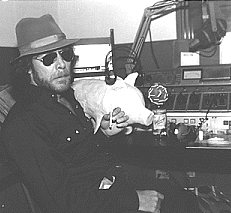
Stephen
Capen at
KSAN San Francisco |
|
| |
During the 1990s you conducted many interviews which ended
up in print, and many more that can be found on the Internet.
You talked with major celebrities and also got into some weighty
issues. Is it presumptuous to say your career was evolving?
My track
record in radio and writing is the greatest argument against
career evolution ever waged. I went from working behind the
counter at a newsstand in San Francisco to the biggest market
in the country. I was promoted by at least two radio stations
as joining them imminently and then never showed. I left San
Francisco radio to study Jungian psychology and ultimately
landed in the rural outskirts doing hog reports and working
the Latino gang beat. I was privileged to interview some of
the finest and most original authors, revolutionary thinkers,
and talented performers in the world but it was a bust freelancing
at a few hundred dollars a pop. It was a really hard dollar.
Thirty
five years later, what does the Hartford chapter say in the
Life Story of Stephen Capen?
Mama don't
let your children grow up to be deejays. Unless you want them
to wake up one day realizing that what they do for a living
is sit in a padded room speaking into a lead pipe.
I josh.
It was at once both my introduction to big time radio and
a period of the greatest transition in my life. Everything
happened so fast and furiously I'm just now beginning to make
sense of it. To me Big D was what rock & roll radio
could be, and still can be, like the early '60s WBZ Spirit
of New England days of Bradley, Kaye, Summer, Carl de Suze
and even Jay Dunn. A highly credible and respected news department.
A time when rock & roll hit a high water mark. And it was
orchestrated by one of the most talented, likable, generous
people ever to grace the business, Charlie Parker. I mean,
for openers, with a name like that how can you lose?
When I
was a kid I listened to a Hi Fi - as opposed to WiFi -- in
the corner of the living room. On the wall above the Magnavox
were plastic music notes and instruments my artsy mother,
being the consummate hostess and performer, had decorated
with. At times I'd get so caught up in the music I'd grab
the saxophone off the wall and be wailin' -- pretend, you
know? Caught up in the music, where you can't sit down. Playing
to an invisible audience. I'll paraphrase Greil Marcus's book,
Like A Rolling Stone, which he dedicates "to radio," where
he might be characterizing radio as well as anyone ever has:
"when it comes on the radio, it's a surprise. It breaks
the day, it gives you a lift and, suddenly, 'OK, I'm sticking
with the story as long as it lasts.' It's a gift when it comes
from the radio."
Stephen
Harold Capen died in Plymouth, MA on September 12,
2005 at the age of 59.
|
|
|
|