













©
2004-2026
Man From Mars Productions

|
Daniel
E. Noble
|
 |
|
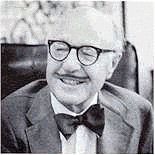
The February 1, 1939 issue of Broadcasting magazine mentioned FM experiments in the 100 MHz band by Professor Noble of Connecticut State College. Four months later Broadcasting reported Noble had permission to use the 100-watt station to broadcast using the FM method developed by Major Edwin H. Armstrong. |
|
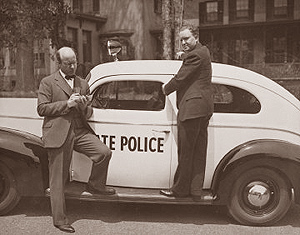
The station was not for the public's ears, however. Noble was developing a system of frequency modulation broadcasting specifically for law enforcement. It should be pointed out that at the time, police communications were limited. Most beat cops telephoned in periodically from dedicated call boxes on the streets of major cities. Some departments had one-way radio systems that allowed headquarters to dispatch patrolmen, but they had no way to acknowledge. Car-to-car communication didn't exist. Connecticut State Police commissioner Edward J. Hickey asked Noble to find something better. Noble designed the circuitry and and prototype was constructed by the Fred M. Link Company. (right:) Dan Noble and Connecticut state radio supervisor Sidney Warner with one of the cruisers in which an FM two-way radio communication system was installed in 1940. In the process,
Connecticut became the first to establish a statewide two-way radio
communications system, and the first to employ FM technology. |
|
 |
In 1940 State Police awarded a contract to Link Radio Corporation to outfit the entire state, and that work attracted the attention of the military. In October, a contingent from the U.S. Army Corps of Engineers visited Hartford for a demonstration. Noble's work came to the attention of Paul V. Galvin, owner of a Chicago radio manufacturing company. He invited the Professor to take a leave of absence from UCONN. Noble never returned to academia, spending the next 30 years with Galvin's renamed Motorola, Inc. The two took on development of FM communications gear for the U.S. Army Signal Corps. |
|
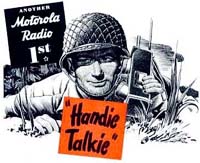
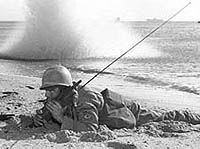
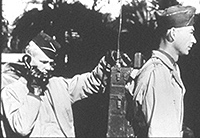
Motorola's SCR-536 "Handie-talkie" was a two-way FM radio that saw use in virtually every theater of World War II. The Army later awarded Noble with a Certificate of Merit for his work in developing Motorola's SCR-300 "Walkie-talkie." Noble later became interested in the application of transistors in FM mobile systems. |
 |
 |
In 1948 Noble persuaded Galvin to open a major R&D facility in Arizona that helped make Motorola one of the world's leading semiconductor manufacturers. Bolstered by the new market for solid state technology, the company thrived. Noble climbed Motorola's corporate ladder becoming director of research, a vice president, and later vice chairman of the board, long outliving founder Galvin. The Connecticut native was showered with honors during his illustrious career. He held nine electronics patents. |
|
In 1976 he was named one of UCONN 's Distinguished Alumni. In 1978 the Institute of Electrical and Electronics Engineers awarded Noble the Edison Medal for leadership and innovation in meeting important public needs. Arizona State University opened the Daniel E. Noble Science and Engineering Library in 1983, hailing him as the Father of Arizona Industry. In 2000 the IEEE established the Daniel E. Noble Award was established for outstanding contributions to emerging technologies He died February 16, 1980, at the age of 78. |
|