













©
2002-2025
Man From Mars Productions

|
Reeth
& King
|
 |
|
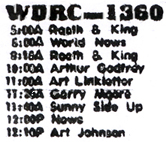
One was WORL in Boston, another was WDRC. They were interested, but didn't contact us personally at first. Buck Forker, former Sales Manager of WNEW was the GM of WDRC and he called the General Manager of WHOL to question him about us. Buck telephoned from Hartford while we were appearing in Philadelphia, told us he was interested and wanted us to go to New York ASAP to meet with Buckley and Jaeger. We told him we didn't close in Philly until Saturday night and he said they'd like to meet right away and could we be at their office in New York early Sunday morning. We caught the 5 AM train from Philadelphia and were at their NY office, chatting and drinking Ambassador 25 Scotch with them at seven-thirty Sunday morning. By ten, we had hammered out a deal and signed contracts, prepared by their private secretary, who welcomed us when we arrived. She also poured the drinks. As I recall, we met with Dick Buckley and John Jaeger in December of 59 and started at WDRC shortly after January 1st, 1960. Eddie and I arrived in Hartford on a Sunday morning and rented the top floor of a huge Victorian on East Blue Hills Avenue, several blocks from the station. That night we met with Buck (Victor) Forker and Charlie Parker at the station. We brought with us, the large sound effects door through which our characters entered and left. The door was confiscated from the SFX department of the defunct WSAN Drama Workshop, in Allentown. Until that moment, although we had spoken with Buck via telephone, we had never heard of Charlie Parker, who proved to be an instantly likeable guy. The Sales Manager, a blatantly unfriendly man, whose name escapes me, was also present and I sensed an instant dislike between him and Eddie. Frankly, I wasn't too crazy about him either. Apparently, whoever was on the air that night had taped their show, since they sent us into the broadcast studio with a program log and copy book and had us ad-lib a half hour, while they watched and listened from the control room. One character we used that night was a Hartford insurance agent, who was a threatening hoodlum trying to sell us health insurance. Buck and Charlie Parker laughed a lot. The Sales Manager stomped out before we finished. Eddie said he was probably Bacon or Faye's brother-in-law. I figured he resented the changes Buckley Jaeger brought to his comfortable world. In any event, we didn't exchange a dozen words during our tenure at WDRC. The following morning at five we hit the air. |
 |
Q: At first, WDRC put Bob Bacon and Dick Fay together for a two-man morning team. Did you ever hear them, or even meet them, or were you and Eddie hired as replacements with no knowledge of your predecessors? A: John Jaeger had told us about the Bacon and Fay show, but we never met them. As Buck Forker related in his letter to John Jaeger, he simply believed we would be more suited for AM drive. Russ Naughton was never mentioned. Q: During your time at DRC the whole shooting match was in Bloomfield at the transmitter building. What was the facility like? Did your show rely much on recorded drop-ins and what kind of equipment was used? Had they installed cart machines or were they playing sound effects back from records? |
|
Mike Stein did most newscasts. Bud Steele and George Freeman shared time on the others. All three were terrific and truly big-league. In keeping with the John Jaeger philosophy, made famous at WNEW, they used actualities and scooped other stations as often as possible. When there was a plane crash in the news, all airline commercials were instantly cancelled. One morning, while we were on the air, a 727 crashed in an Indiana cornfield. I believe it was Bud Steele who contacted the farmer who owned the field, by telephone and scooped the country. He put him on the air live and the guy related how he had discovered and walked among the wreckage. He graphically described the ghastly scene, complete with body parts, blood and gore. Eddie and I nearly threw up. We didn't know how to follow the farmer. Mainly, we just did time checks and played music, without trying to do comedy. The WDRC facility was quite good as far as we were concerned. We worked at a table in a large, comfortable, dimly lit studio. The engineers union forbade us from touching any equipment and we used hand signals to start the music and commercials. We received special permission to have a turntable in the studio for the few drop- ins we used. There were no cart machines and all sound effects were on record. Outside the studio and a short walk down the hall, was the huge record library, Bertha Porter's domain. On the other side of the studio was the production room. The offices were in an area behind the control room. |

 |