|















©
2008-2026
Man From Mars Productions

|
| |
|
Like every
other aspect of life, America's entry into World War II had
a drastic impact on broadcasting. From the moment of the attack
on Pearl Harbor on December 7, 1941, a patriotic fervor gripped
the country. It was clear that major changes were coming.
In January
1942 it was announced that 11 WDRC programs would be
canceled or revised to comply with new censorship rules issued
by the War Department. Notably, no further telephone or telegraph
music requests would be accepted by the station. Owner Franklin
M. Doolittle said even mailed requests would be scrutinized
closely to be sure they didn't carry hidden messages which
might benefit the enemy. It was an era when the slogan, "loose
lips sink ships," was a creed to live by.
The weekday
afternoon man-on-the-street interview program Main Street,
Hartford was canceled outright, replaced with a musical
program.
|
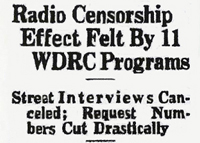
The Hartford Daily Courant
January 17, 1942
|
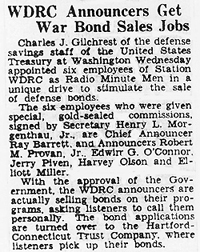 The
Hartford Daily Courant
The
Hartford Daily Courant
March 19, 1942 |
In March,
the U.S. Treasury launched a national program to sell defense
bonds in order to pay for the ramp-up of America's military
machine. The six WDRC staff announcers were commissioned
to sell bonds to listeners during their broadcasts.
Radio
was predominately a male occupation, at least as far as most
on-air staffs were concerned. One by one, the male announcing
and technical crew resigned to join the war effort. The first
to go was transmitter engineer Carl Milner who joined the
federal government in a civilian radio capacity. He left in
late March.
WDRC
did a live broadcast from an American Red Cross plasma bank
to educate listeners about the need for blood.
As it
became obvious that replacing male personnel was going to
be difficult, WDRC began training its entire female
office staff for double duty. Under the direction of Chief
Engineer Italo A. Martino
and Chief Control Operator Louis House, a program was developed
to train stenographers, typists and secretaries to operate
transmitters and control consoles.
The first
to take over the main control board was Mr. Doolittle's personal
secretary, Rose Pescik, who took over the early morning Shoppers
Special program on June 10.
|
|
The next
day development engineer Kenneth McLeod said farewell to begin
a government research post.
On June
17 control operator Stanley Peer departed to join the U.S.
Coast Guard.
In July
Mr. Doolittle himself was appointed a technical advisor on
frequency modulation broadcasting at the Board of War Communications
in Washington, DC.
In August,
announcer Elliott
Miller was next out the door, signing up with the Civil
Air Patrol. He was replaced by Russell
Naughton (whose own lengthy WDRC career would be
interruped by a stint in the Army starting in June 1943).
On September 11, Bob
Provan enlisted in the Army. Announcer Edwin
O'Connor soon joined Stanley Peer in the Coast Guard.
On September 18 Chief Announcer Ray
Barrett departed for Uncle Sam's Army. Before long transmitter
engineers Carl Milner and Larry Grant were also in uniform.
On October
8, 1942 announcer Jerry
Piven also left for the Army never to return; he was killed
in the line of duty on December 6, 1944 and is buried in Luxembourg.
Piven was replaced at WDRC by Charles
B. Haaser of Springfield. The same month Haaser started,
so did Rodney
L. Swift, who was imported from Rochester, NY.
|
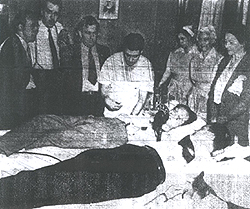
May
2, 1942 - WDRC announcers Ray
Barrett & Bob Provan donate plasma as colleagues and Red
Cross technicians look on. |
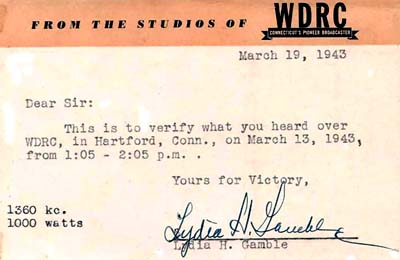
One
of the duties assumed by Lydia Gamble during World War II was
the issuance of QSL verification cards to distant WDRC listeners. |
November 2, 1942 was the day Jean Kirwan left the secretarial
staff to become WDRC's first fulltime female control
operator. After the war she became Mrs.
Russell Naughton. She was later joined by Lydia Gamble.
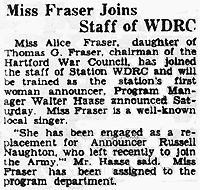
A regular singer on WDRC became part of the announcing
staff on June 26, 1943. Alice
Fraser replaced Army
Private Naughton.
Billboard
Magazine surveyed various radio stations in June 1943
on the impact of war staffing. Program Manager Walter
Haase was quoted as saying WDRC lost 12 of its
30 announcers, control operators and transmitter men to the
military or government defense positions. He said:
"...two
physically handicapped men, one a control and transmitter
operator, the other an announcer, have been employed. A
part-time high-school boy works on FM."
In
January 1944 The Courant reported news of a former
WDRC announcer, then earning his living as a Marine
First Lieutenant in the South Pacific. Frank
W. Stuhlman was a bomber pilot who received commendation
for his actions against the Japanese as the Allies landed
on Bougainville in the Solomon Islands.
|
|
Whenever
possible WDRC reported on news of Connecticut soldiers,
sailors and airmen. The DeMaio family, of Hartford, had four
sons in the service. Marine Corporal Anthony DeMaio was among
the first to land at Guadalcanal which he recounted in a broadcast
on August 11, 1944.
On
November 3rd, Major James Garrett of Windsor Locks (no relation
to the WDRC announcer of the same name) recounted his
experiences with the Army Air Corps in Africa, Sicily and
Italy.
Not all
of the hometown news was good, however. The station reported
on April 27, 1945 that the brother of announcer Charles
Haaser, B-17 pilot Lieutenant Walter B. Haaser, of Wethersfield,
was missing in action in the Italian theater of war.
For a
sample of wartime programming aired on WDRC, click
here.
|
Hartford
Daily Courant
June 27, 1943
|
|
|
|