| |
January
2, 1940 - An FCC license renewal application showed that
The Doolittle Broadcasting Co. owned 55% of WDRC; Franklin
M. Doolittle individually owned .2%; partners Lawrence W. Lowman
and Sam Pickard (in trust for Patricia Jane Pickard of Miami Beach)
continued to own 22.4% each.
January
21, 1940 - Franklin Doolittle was elected to the board
of directors of FM Broadcasters, Inc., an organization designed
to further the cause of frequency modulation, or "staticless,"
broadcasting. John Shepard the 3rd, head of the Yankee Network,
was chairman. Among the other directors was WTIC's Paul Morency.
August,
1940 - WDRC AM became a fulltime 5,000 watt directional
station.
September
1940 - W1XPW broadcast a regular program schedule
12 hours a day. Doolittle's newspaper ads stated, "W1XPW is starting
this new schedule so that high fidelity programs will be available
for demonstration purposes, and for reception by purchasers of FM
sets. The September 4th issue of Variety reported:
"WDRC
is divorcing itself from its offspring FM station, W1XPW,
putting same officially on its own two feet Monday [as of
September 16, 1940]. At that time, W1XPW will become
a separate entity, broadcasting its own programming and maintaining
its own staff. Believed to be the only FM in the country to maintain
its own set-up, it will operate at the start on a 12-hour a day
basis."
December
6, 1940 - WDRC Inc. was granted a permit for an
FM station at 46.5mc, distinct from the previous "Apex"
experimental station. Commercial operation commenced January 1,
1941.
 February 14, 1941 - Doolittle's
FM took part in a unique radio relay test. Major Edwin H. Armstrong,
speaking by telephone (from New York) to the Yankee Network studios
in Boston, was fed to Yankee's W1XOJ transmitter at Paxton. The
signal was relayed, by FM, to W1XER atop Mt. Washington...back to
Paxton...on to W1XPW on Meriden Mountain...and on to Armstrong's
W2XMN in Alpine. Engineers at each site spoke freely over the air
with each other, without static. (note: this excerpt was recorded
by WTIC engineer Robert S. Coe [who later joined WDRC]; he
made the recording from the off-air signal of W1XOJ. The first voice
is that of Major Armstrong, followed by Paul deMars of the Yankee
Network.)
February 14, 1941 - Doolittle's
FM took part in a unique radio relay test. Major Edwin H. Armstrong,
speaking by telephone (from New York) to the Yankee Network studios
in Boston, was fed to Yankee's W1XOJ transmitter at Paxton. The
signal was relayed, by FM, to W1XER atop Mt. Washington...back to
Paxton...on to W1XPW on Meriden Mountain...and on to Armstrong's
W2XMN in Alpine. Engineers at each site spoke freely over the air
with each other, without static. (note: this excerpt was recorded
by WTIC engineer Robert S. Coe [who later joined WDRC]; he
made the recording from the off-air signal of W1XOJ. The first voice
is that of Major Armstrong, followed by Paul deMars of the Yankee
Network.)
March
29, 1941 - WDRC AM moved to 1360kc where it remains
today.
May
5, 1941 - The FCC granted W1XPW the first commercial
FM authorization in Connecticut. The calls were changed to W65H
("65" represented the middle numerals of the assigned
wavelength, 46,500 kc; "H" stood for Hartford). It was on
the air every day from 2-10PM. Doolittle published the first general
rate card, selling a one-time hour-long program, in prime time,
for $25.
 |
September,
1941 - W65H aired the first all-request
dance band program on an FM station.
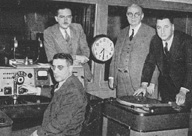
Management
staff of WDRC/W65H (l-r): Italo
A. Martino, engineer (seated); Walter
B. Haase, program director; Franklin M. Doolittle, president;
William F. Malo, commercial manager. click
for enlargement
|
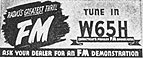
October, 1941 - FM Magazine, p.42 : "W65H,
the FM outlet of WDRC, Hartford, is using billboards
as a part of their efforts to build up their audience. Connecticut
dealers report FM set sales show resulting increase."
click for enlargement |
 |
October,
1941 - W65H aired the first commercial FM program.
Programming consisted of dance, symphonic and classical music...sports...frequent
news programs...live concert and semi-classical music...and interviews.
February
8, 1942
- An additional three hours of daily programs were added to the
schedule of W65H, originating at Major Armstrong's W2XMN
in Alpine, NJ and W43B in Boston.
March
18, 1942 - The U.S. Treasury issued gold seal commissions
to WDRC announcers Ray Barrett,
Robert M. Provan, Jr., Edwin
G. O'Connor, Jerry Piven, Harvey
Olson and Elliott Miller.
They were authorized to sell defense bonds on the air during their
programs.
|
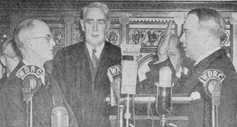
January
7, 1943 - At the capitol in Hartford, WDRC
provided live coverage of the swearing in of Governor Raymond
E. Baldwin (right) by Chief Justice William M. Maltbie (left).
January
27, 1943 - The first concert artist to perform
on W65H was Miss Florence A. Morrison, the same pianist
who performed on WPAJ's inaugural broadcast from New
Haven in December 1922.
|
 |
|
November
1, 1943 - W65H became known as WDRC FM.
February
1, 1944 - WDRC FM increased its schedule
from 6 to 11 hours per day, signing on at 1:00 p.m. instead
of 6:00 p.m.
March
1944 - 19-year-old Charles R. Parker joined WDRC
as a control room operator.
|
|
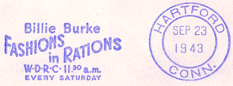
1943
postal frank for Billie Burke's
radio show
|
April
3, 1944 - Doolittle purchased 68 acres atop Talcott
Mountain in Farmington, "as a site for a future television
station and for other future radio purposes." He stressed
TV would not be available on a broad scale immediately after
the war, though frequency modulation would be in general use.
June
16, 1944 - WDRC FM operated at 1.1kw.
1944
- During World War II, Franklin M. Doolittle was appointed
Technical Advisor to the Defense Communications Board in Washington,
DC. Doolittle and Walter B. Haase
(right) assumed co-general manager responsibilities at WDRC
AM/FM.
|
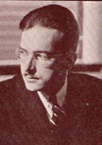
Walter
B. Haase |
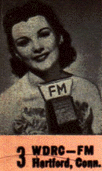
1944
Radio Annual ad |
1944
- WDRC FM was part of New England's FM American
Network (left), relaying wireless programs from New York's
WGYN (via Armstrong's WFMN in Alpine, NJ) to Yankee's WGTR
in Paxton, MA and on to WMTW on Mt. Washington, NH. click
for enlargement.
July
15, 1944 - FCC license renewal paperwork showed
Sam Pickard no longer owned shares in WDRC and WDRC
FM. Doolittle Broadcasting Co. owned 71%; Franklin M.
Doolittle individually owned .2%; Colonel Lawrence W. Lowman,
of the Office of Strategic Services in Washington, D.C., owned
28.8%.
September
17, 1944 - The first broadcast was heard from WDRC's
branch studio in New Haven, for the purpose of special educational
and cultural programs.
|
|
October 2, 1944
- WDRC's first news broadcast from The Hartford
Courant. The programs aired Monday through Saturday evenings
from 6:05-6:15PM. The station aired daily news programs from
the newspaper until 1951. Seated (l-r): managing editor George
Stansfield; political writer Jack
Zaiman; standing: editor and publisher Maurice S. Sherman;
announcer Harvey "Longfellow"
Olson and Franklin M. Doolittle.
August
6, 1945
- FCC ownership forms indicate that Lawrence W. Lowman (back
at CBS following his war service) still owned 144 shares of
common stock in the corporation, or 28.8%. Doolittle Broadcasting
Co. itself owned 355 shares (71%) and Franklin M. Doolittle
owned 1 share (.2%).
September
4, 1945 - Lawrence W. Loman relinquished his post
as Director of WDRC, Incorporated and was replaced
by longtime Vice President and Chief Engineer Italo
A. Martino (below left).
|
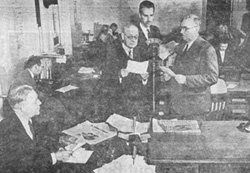
First
WDRC news broadcast from
Hartford Courant newsroom
|
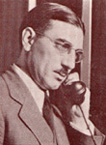
Italo
A. Martino |
September
26, 1945 - The FCC approved WDRC FM's high
band operation at 94.3mc, while continuing low band operation
at 46.5mc, effective January 1, 1946. Simultaneous operation
on both frequencies was authorized for a period of time, so
various sources provide conflicting information on the station's
precise frequency during the next few years.
November
19, 1945 - WDRC debuted a wire recorder by broadcasting
a pre-recorded interview with Hartford Mayor Mortensen.
February,
1946 - A list of stations in The Journal of
Frequency Modulation (p.22) indicates WDRC FM was
broadcasting at 94.3mc with 7kw of power.
|
 |
November
8, 1946 - WDRC FM shifted to 106.3 MHz in
the high band, keeping its low band frequency of 46.5mc.
March
20, 1947 - The FCC directed WDRC FM to yet
another new frequency, 94.3mc.
May
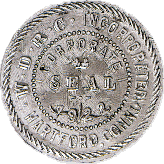
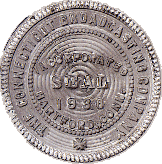
22, 1947 - WDRC Inc. became Connecticut
Broadcasting Company. Doolittle continued to own 60% of the
stock; Haase and Martino owned 20% each.
|
 |
 |
June
12, 1947 - NAB records indicate WDRC FM was
broadcasting on 93.7mc with 7kw of power. |
 |
June
19, 1947 - On a Thursday night, the three-month old
Continental Network, comprised of all FM stations, aired a concert
by the USAAF Band from Bolling Field (near Washington, DC) on
18 stations using wire and over-the-air relay stations. WDRC
FM played a pivotal role, delivering the signal to northern
New England's Yankee Network affiliates. click
for enlargement |
|
March
29, 1948 - WDRC FM operated at 94.3 MHz.
April
11, 1948 - FM programs were picked up direct from
New York, without wires, and re-broadcast to WDRC FM
listeners.
December
31, 1948 - WDRC FM ceased broadcasting on
the low band frequency of 46.5 megacycles. It continued broadcasting
on 93.7mc as authorized in March, 1947.
|
 |

|
|