













©
1999-2025
Man From Mars Productions

|
History
|
 |
 |
 |
 |
 |
 |
 |
 |
 |
 |
|
|
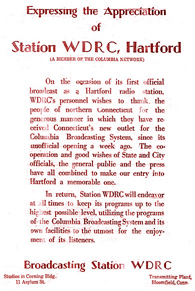
November 24, 1930 - WDRC closed its studios at the Hotel Taft in New Haven and moved the equipment to Hartford. December 5, 1930 - At 5:00PM, WDRC greeted its new audience with live music programs from studios in the Corning Building at 11 Asylum Street. The transmitter was housed at 783 Blue Hills Avenue in nearby Bloomfield. WDRC became the 76th affiliate of the CBS Radio Network. December 11, 1930 - CBS officially welcomed WDRC to its roster with a nationwide hookup from 10:30-11:30PM. Governor John H. Trumbull and Hartford Mayor Walter E. Batterson were among the speakers. The Guy Lombardo and Ben Bernie orchestras were featured performers. March, 1931 - The licensee name was changed from Doolittle Radio Corporation to WDRC Incorporated. June, 1933 - Franklin M. Doolittle asked the Federal Radio Commission for authority to increase power from 500 to 1,000 watts. He submitted a detailed financial statement indicating WDRC made a net profit of $34,787.96 in 1932 on its investment of $5,000. September 23, 1933 - Power was increased to 1,000 watts. |
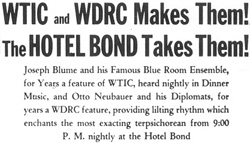
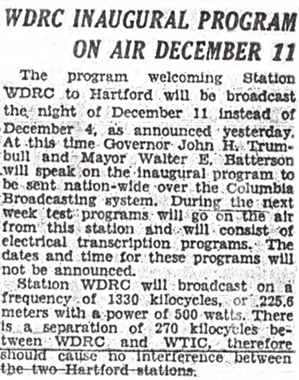 The Hartford Daily Times, Tuesday, December 2, 1930, p.23 |
|
|
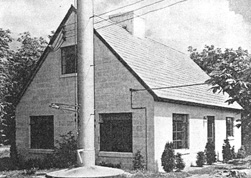
February 13, 1934 - A routine FRC license renewal application revealed that WDRC Incorporated was owned as follows: New Haven Broadcasting Co., of Hartford, 50%; Sam Pickard, of Rye, NY, 22.4%; Lawrence W. Lowman, of New York, 22.4%. Pickard and Lowman were both CBS vice presidents. April 27, 1934 - The FRC authorized an increase to 2,500 watts day, 1,000 watts night. October, 1934 - A new transmitting station was built at 785 Blue Hills Avenue in Bloomfield, 40 feet from the original structure. December, 1935 - The station began utilizing a new 310-foot tower at the Bloomfield transmitter site. Click for photo; note 3 towers.
March, 1936 - New England sustained $100 million damage in a series of deadly floods. WDRC provided coverage by candlelight when heat and lights went out in downtown Hartford. Click for a photo of 1936 flood coverage. 1936 - Doolittle received permission to operate W1XSL, one of twelve "Apex" AM high frequency stations on an experimental basis. It was built on the west peak of Meriden Mountain and operated at 40,300kc (40.3mc) with 1kw of power. May 16, 1936 - WDRC moved from 11 Asylum Street to new studios in the 16th floor penthouse of the Hartford Trust Company (later Connecticut Bank & Trust) building at 750 Main Street in Hartford. |
|

|